
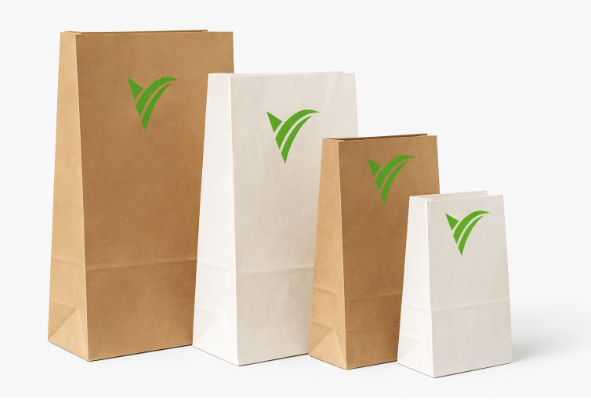
How to Calculate Your Business’s Monthly Paper Bag Requirements
Estimating monthly paper bag requirements helps businesses control costs and avoid shortages or excess inventory. Retail shops, cafés, bakeries, supermarkets, and online sellers use bags at different rates. Before comparing paper bags in bulk price, calculate usage, required sizes, and likely demand changes.
Combine sales data, average bags per transaction, seasonal changes, and safety stock to create a practical forecast.
1. Start With Your Monthly Sales Data
Review sales records from the previous three to six months. Note monthly transactions and identify patterns. New businesses can use weekly figures or expected footfall until actual data accumulates.
Revenue alone is not a reliable measure of bag consumption: a store selling a few expensive items may use fewer bags than one processing many small transactions. Separate ordinary days from weekends, holidays, promotions, and unusually quiet periods to improve the estimate.
2. Calculate Bags Used Per Transaction
Estimate how many bags customers need per purchase. Some need one bag; others require separate bags for fragile goods, food, or items that should not be packed together.
Sample transactions to calculate an average. For example, 500 transactions using 575 bags equal 1.15 bags per transaction.
Formula:
Monthly transactions × average bags per transaction = estimated monthly bag use.
If you expect 4,000 transactions and use an average of 1.15 bags per transaction, your estimated requirement is 4,600 bags before adding reserve stock.
Use your own records whenever possible. A short counting exercise over several busy and quiet days can provide a better estimate than relying on assumptions. Make sure staff count bags actually issued rather than bags prepared in advance, since unused bags may be returned to storage. If customers sometimes bring their own reusable bags, account for that behaviour too. Review the figures after changes to checkout procedures or product packaging, because these can alter how many bags are used per sale.
3. Separate Requirements by Bag Type and Size
A total does not show which bags to order. List the sizes and styles you use, such as small, medium, large, SOS, flat-handle, or twisted-handle bags.
Estimate each type’s share of monthly usage. If 50% of 4,600 bags are small, 35% medium, and 15% large, order forecasts of 2,300, 1,610, and 690, respectively. Review proportions when products or buying habits change. Correct sizing reduces waste. Keep a simple record of which bag type is used for common purchases, such as one garment, a boxed item, or several grocery products. This helps staff choose consistently and makes future estimates more accurate.
4. Account for Seasonal and Promotional Changes
Demand changes during festivals, holidays, sales campaigns, tourist seasons, launches, and local events.
Compare the same period in previous years when possible. For promotions, estimate additional transactions and bags required. Avoid unsupported seasonal allowances that may leave unused stock. New businesses can use campaign plans and expected traffic, then revise estimates when actual results arrive. If demand rises sharply for one product category, adjust only the relevant bag type instead of increasing every order equally. This avoids overstocking styles that are not affected by the promotion.
5. Add a Practical Safety Stock
Safety stock protects against unexpected demand, delivery delays, and damaged bags. The reserve depends on sales predictability and supplier lead time.
A starting point is 10% to 15% of forecast usage, adjusted through experience. For 4,600 bags, a 10% reserve adds 460, creating a target of 5,060 bags.
This is only a planning example. Short, reliable lead times may require less stock; longer schedules may require more. Keep reserves proportionate to risk and storage space. Paper bags should be stored in a dry, clean area away from moisture, dust, and direct damage. Poor storage can make otherwise usable stock unsuitable, so include storage conditions when deciding how much inventory to keep.
6. Subtract the Stock You Already Have
Count usable stock before ordering, separated by type and size. Exclude damaged, wet, or incorrectly printed bags.
Formula:
Forecast requirement + safety stock − usable inventory = quantity to order.
If your target is 5,060 bags and 1,200 usable bags remain, order 3,860. Account for outstanding orders arriving before current stock runs out. A weekly inventory sheet can prevent duplicate orders and improve purchasing visibility. Record stock by size, style, and print version, particularly if several branches share a central store. The physical count should be compared with the inventory record periodically, since recording errors can distort the calculated order quantity.
7. Use the Forecast to Plan Your Budget
Request quotations for the required sizes, paper specifications, handles, and printing. Compare total cost, including setup, transport, taxes, packing, and minimum quantities.
When reviewing paper bags bulk price, compare equivalent specifications. A cheaper bag may use thinner paper or differ in size, handles, or finish. Test samples with representative products before placing a large order.
Consider storage and cash flow too. Bulk buying may lower unit cost but ties up money and space. Balance price against delivery reliability and actual usage. Ask suppliers about production lead times, payment terms, order flexibility, and how they handle defects or delayed shipments. If branding changes frequently, avoid ordering more printed bags than you can use before the artwork becomes outdated. For standard designs used year-round, larger quantities may be easier to plan.
8. Set a Reorder Point and Review Monthly
Set a reorder point rather than waiting until stock runs out. Multiply average daily usage by supplier lead time, then add safety stock.
If you use 170 bags daily, delivery takes seven days, and safety stock is 500 bags, reorder at 1,690 bags. Adjust for incoming deliveries.
At month-end, compare forecast and actual usage. Record shortages, leftovers, promotions, and supplier delays to improve future estimates. Assign one person to update the figures and share them with purchasing staff. A review process makes forecasting part of routine operations rather than an emergency task.
Conclusion
Calculate monthly needs using transaction data, average bags per purchase, bag-type proportions, seasonal changes, and safety stock. Subtract usable inventory and review actual usage monthly to avoid shortages and excess packaging.
When selecting paper shopping bags, consider size, strength, handles, printing, delivery schedules, and order quantities. VTPL, also known as Vignnesh Techpack Pvt. Ltd., lists SOS, flat-handle, twisted-handle, grocery, sheet-fed, and e-commerce bags, plus printing and customisation. Its website provides information businesses can review when assessing packaging needs.