
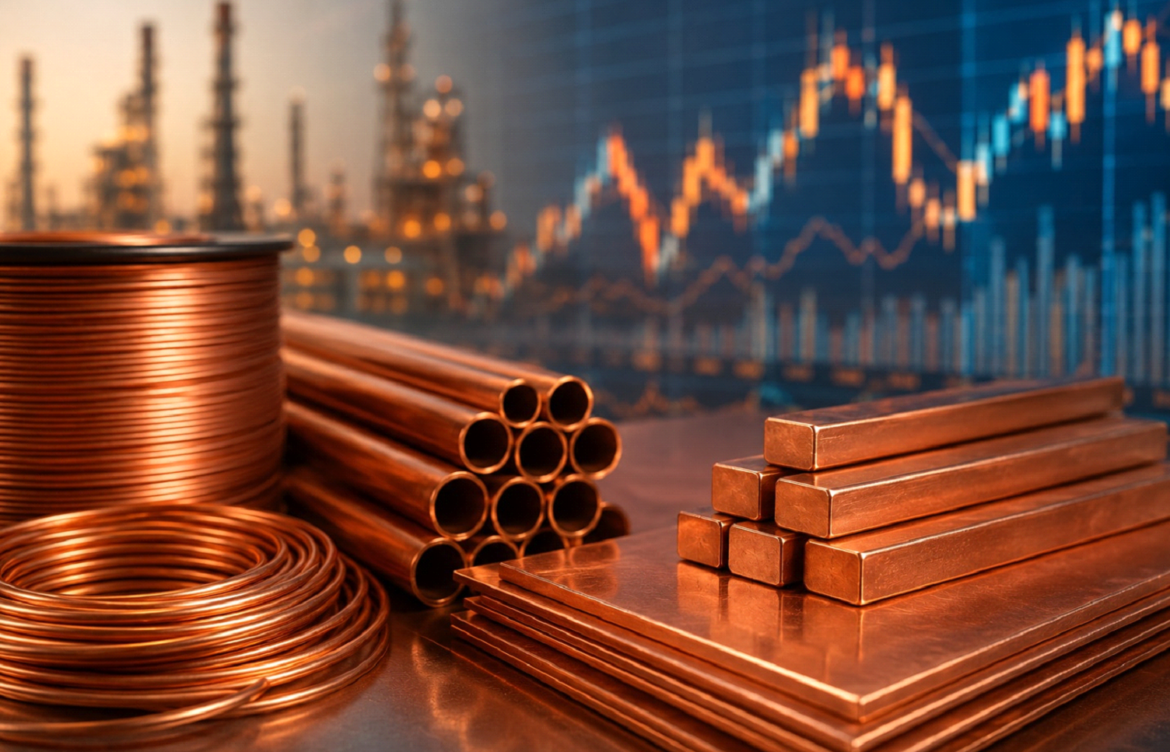
Copper Price Trend: Latest Market Insights for Investors and Procurement Professionals
Copper used to be the metal nobody really talked about at dinner parties. Predictable, tied to construction and factory output, moving in slow cycles most people ignored. That’s changed, and honestly it changed faster than a lot of analysts expected. Sit in on an investment call in 2026, or even a routine procurement meeting, and someone brings copper Prices up within the first ten minutes. AI infrastructure spending, EV adoption, renewable energy projects — three separate booms, all fighting over the same red metal at the same time.
Where Prices Stand Right Now
Copper’s been trading near record highs for most of the first half of this year. We’re talking north of $13,000 a metric tonne on the major exchanges, and COMEX futures cleared $6.15 a pound back in early July. Not a straight line up, though. Anyone watching the charts since mid-June has seen it swing hard both directions, sometimes recovering losses within the same week.
Why the whiplash? Partly inflation numbers. Partly tariff noise that won’t quit. And partly the Middle East situation, which keeps injecting risk premium into basically every commodity market right now. The Fed left rates alone in June — 3.5 to 3.75 percent — and everyone’s waiting to see what happens at the late-July meeting. Rate hikes usually hurt industrial metals. Copper’s shrugging it off better than most, which tells you something about how deep the demand story goes.
The Demand Side of Things
Nobody saw AI data centers becoming a copper story five years ago. Now it might be the single biggest new demand source out there. These buildings need way more wiring and cooling infrastructure than older data centers — a big one can chew through 3,000 to 5,000 tons of copper just getting built, then another 20 to 30 tonnes per megawatt to keep running. That’s a staggering number for an industry that, at this scale, is basically brand new.
Electric vehicles haven’t slowed down either. Roughly four times the copper of a gas car once you add up the battery, motor, and wiring. Sure, manufacturers keep trying to shave that number, but production volume keeps growing faster than the savings. And then renewables pile on top — solar in particular needs about five times more copper per megawatt than a gas-fired plant does, per IEA numbers. Grid upgrades add more still, quietly, without ever making a headline.
Why Supply Can’t Catch Up
Mine output is inching up around 1.4 percent a year. Demand isn’t inching anywhere — it went from about 26.7 million tonnes in 2024 and is on track to hit 31.3 million tonnes by 2030. Do that math and you get a gap. Just for this year, the shortfall could land anywhere between roughly 124,000 tonnes, if things go okay, and half a million tonnes, if they don’t — a wide range, but that’s what happens when nobody really knows how fast the mines can adjust.
Most of the world’s copper still comes out of Chile and Peru, and neither has had an easy year — strikes, protests, and mines that just aren’t producing as rich ore as they used to. New mines aren’t a quick fix. Fifteen to twenty years from discovery to actual production is normal, so whatever’s coming online by 2035 is largely locked in already — there’s no fast lane here.
Tariffs Complicate Everything
Since mid-2025 there’s been a 50 percent Section 232 tariff sitting on semi-finished and derivative copper imports (refined cathodes got carved out, for now). That kind of policy shift ripples through procurement almost overnight — sourcing gets reworked, contracts get renegotiated, and sometimes buyers rush purchases before costs climb further. There’s also talk of a possible tariff on refined copper itself. If that lands, expect trade flows to shift again.
What the Big Banks Are Forecasting
J.P. Morgan’s calling for copper to average around $12,075 a tonne this year, with quarterly peaks near $12,500. Citigroup’s more aggressive — they think $15,000 a tonne is possible if the supply gap keeps widening the way it has been. Not everyone agrees, though — a handful of analysts think refined copper might actually tip into a modest surplus before the year’s out, and if that happens, it’d take the edge off the rally for a bit even though the bigger structural problem isn’t going anywhere.
If You’re Investing
Copper isn’t behaving like a boring cyclical metal anymore. It’s starting to look like a strategic growth play, and institutional money has noticed — capital’s been shifting out of precious metals and into copper on the theory that AI and electrification demand aren’t going away. You can play this through ETFs, mining equities, or specific producers. Expect volatility to stick around regardless. But if the supply-demand gap holds up the way current data suggests, dips might be worth buying rather than fearing.
If You’re Sourcing Copper for Procurement
A few things worth doing now rather than later. Lock in longer contracts while you still can. Spread sourcing across more than one region — Chile and Peru alone carry too much labor risk to bet everything on them. Watch tariff headlines closely; they move fast and hit landed costs harder than most people expect. And take recycled copper seriously. It’s not a compromise option anymore, not with primary supply this constrained.
Common Questions People Ask
Why’s copper at record highs right now? Mostly a convergence — AI data centers, EVs, renewables, and tight mines all pulling the same direction at once.
People also ask how much copper one of these AI sites actually eats up — and honestly, it’s a lot. A big build can go through thousands of tons, somewhere in the 3,000-5,000 range, before it’s even switched on, and then it keeps drawing another 20-30 tonnes for every megawatt once it’s live.
Whether this keeps up for the rest of the year is the harder question. Most of the big banks lean toward yes, with numbers clustering somewhere in the $12,000-$15,000 range, but getting there won’t be a straight line — expect more of the same back-and-forth we’ve already seen.
What’s actually causing the shortage? Old mines with declining ore quality, new mines that take decades to build, and labor disputes concentrated in the two countries that dominate supply.
Bottom Line
The price is really just a symptom here. The underlying cause is a handful of massive, already-funded shifts in how the world builds and powers things — data centers, EVs, renewables — running headlong into a mining industry that physically can’t expand fast enough to match. For investors, that’s a case for staying long on the metal even through the bumps. For procurement teams, it’s less about panic and more about getting ahead of the curve before contracts get more expensive than they already are.