
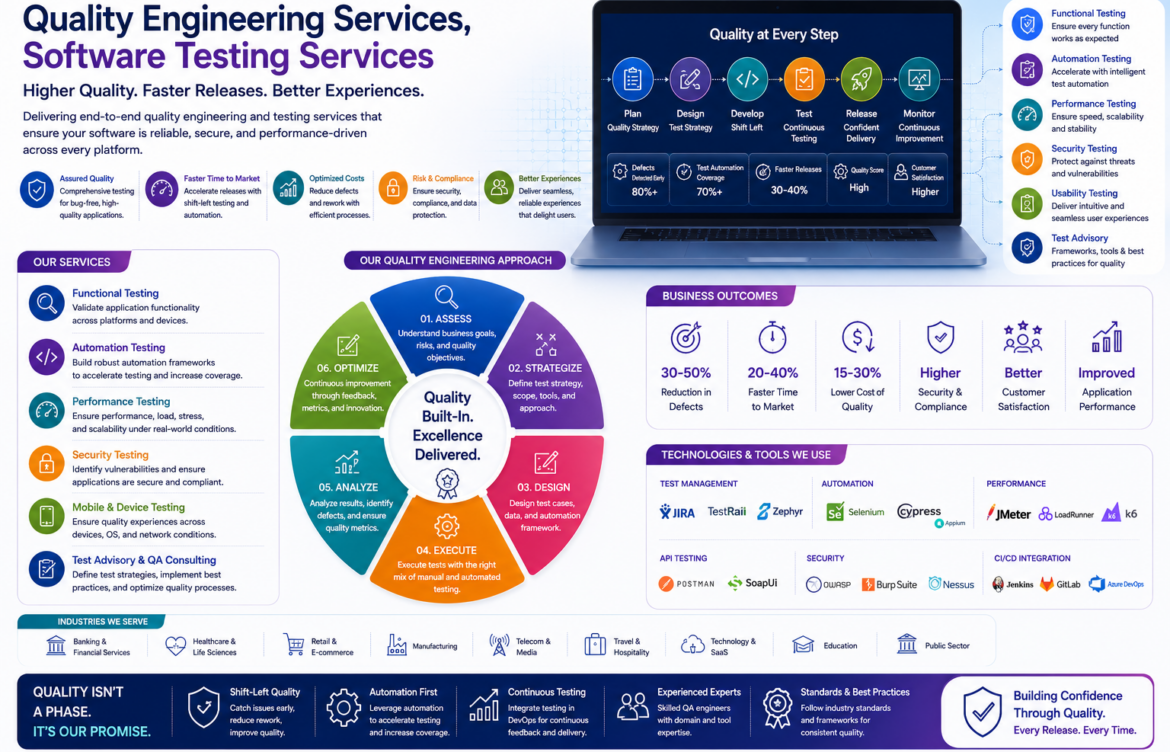
Quality Engineering Services: Rethinking What Software Testing Services Should Deliver
For years, software testing services were viewed as a final checkpoint — a phase that happened after development, right before release. That model no longer fits how modern software gets built. Quality engineering services represent a broader shift: treating quality as something engineered into a product from the very first sprint, not something inspected in at the end.
For enterprises still running testing as a late-stage gate, understanding this shift is essential to keeping pace with faster release cycles. The transition takes time, but the productivity and quality gains for teams that make it are dramatic and durable.
From Gatekeeping to Engineering
Traditional software testing services operated as a gate: code was written, then handed off to be tested, then either passed or sent back. This model works when release cycles are measured in months, but it collapses under continuous delivery, where new code ships multiple times a day. Under those conditions, gatekeeping becomes a bottleneck rather than a safety net.
Quality engineering services replace this gate with a continuous discipline — testers embedded alongside developers from design through deployment, catching issues when they are cheapest to fix rather than after they have been built on top of. The relationship between developers and testers changes from adversarial to collaborative.
Shift-Left Testing in Practice
Involving quality engineers during requirements and design discussions surfaces edge cases and testability concerns long before a single line of code is written, dramatically reducing late-stage rework. Small early investments prevent expensive late-stage surprises.
Testers as Quality Coaches, Not Just Executors
In mature quality engineering practices, testers help developers write better unit tests and design more testable code, rather than simply executing test cases after the fact. This multiplies the impact of every quality engineer on the team.
Where Traditional Software Testing Still Matters
None of this makes traditional software testing services obsolete — exploratory testing, usability evaluation, and complex end-to-end scenario validation still require skilled human testers who understand the product deeply. Automation cannot replace the human intuition that spots usability problems or unusual failure modes.
The difference is scope: instead of being the sole safety net for quality, these testing activities become one layer within a broader quality engineering strategy that also includes automation, performance testing, and security validation woven throughout development.
- Embedded quality engineers participating in sprint planning and design reviews
- Automated unit and integration tests running on every code commit
- Exploratory and usability testing reserved for skilled human testers
- Performance and security testing treated as continuous practices, not final-phase checks
- Production observability treated as an extension of the testing discipline
- Chaos engineering exercises that validate resilience under real failure conditions
Testing in Production and the Rise of Observability
One of the biggest changes in modern quality engineering services is the growing acceptance that not every quality problem can — or should — be caught before production. Some behaviors only emerge under real user load, real network conditions, and real data. This has elevated production observability to a first-class quality discipline.
Modern teams instrument their applications heavily, run canary releases and feature flags, and treat production monitoring signals as an extension of their testing strategy. When something unusual happens in production, the team learns from it and feeds that learning back into the test suite. Software testing services that ignore this feedback loop leave significant value on the table.
The Organizational Shift This Requires
Moving from traditional software testing services to full quality engineering services is not just a process change — it is an organizational one. Testers need new skills in automation and CI/CD tooling, and developers need to take on more responsibility for testing their own code. Leadership needs to invest in training and be patient with the transition.
Enterprises that invest in this transition, including tooling, coaching, and clear success metrics, consistently see faster releases and fewer late-stage surprises, because quality issues surface weeks earlier than they would under a traditional testing model.
Common Pitfalls in the Shift to Quality Engineering
Making the transition from traditional software testing services to modern quality engineering services is rarely smooth. Recognizing the common pitfalls in advance helps teams navigate the change with less friction.
- Renaming the QA team without changing how testers actually work day to day
- Expecting developers to own testing without giving them the tools, training, or time to do it well
- Underinvesting in test data and environment management, then blaming automation for unreliable results
- Treating shift-left testing as an event rather than a sustained cultural shift over many quarters
- Ignoring production observability as a source of quality signal that should feed back into tests
- Measuring quality engineering services by test count rather than by defects prevented and MTTR
Best Practices for a Sustainable Quality Engineering Practice
Sustaining a mature quality engineering discipline is more challenging than launching it. The teams that keep the quality bar high year after year apply a consistent set of practices that reinforce the culture over time.
- Include quality metrics in every engineering scorecard so they are treated as first-class outcomes
- Invest in continuous learning for testers and developers so skills keep pace with tooling evolution
- Publish quality retrospectives openly so lessons travel across teams rather than staying local
- Treat production incidents as opportunities to strengthen the test strategy, not just to restore service
Actionable Insights for Enterprise Leaders
- Involve quality engineers in design and requirements discussions, not just post-development testing
- Invest in automation training for testers to help them contribute earlier in the development cycle
- Keep exploratory and usability testing as a dedicated, human-led discipline within the broader strategy
- Track how early in the development cycle defects are caught as a key quality engineering metric
- Treat production observability as an extension of your software testing services, not a separate function
- Communicate the transition to quality engineering services as an investment in speed and resilience, not just quality
Conclusion
Quality engineering services do not replace software testing services — they redefine when and how testing expertise gets applied. Enterprises that make this shift build products with quality baked in from the start, rather than inspected in at the end, resulting in faster releases and software that holds up under real-world use.